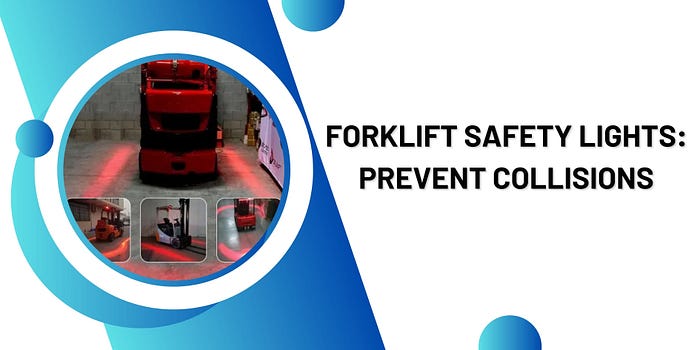
A forklift danger zone warning light projects a highly visible red or blue beam onto the floor to create a “Halo” or “Red Zone” around moving equipment. This serves as a clear visual warning for pedestrians to maintain a safe distance, helping to prevent collisions and injuries in loud or busy environments where audible alarms may be ineffective.
Types of Forklift Warning lights
- Red Zone/Halo lights: These are typically mounted on the sides of the forklift and project a bright red line on the floor, indicating a “no-go” area. This is particularly useful for alerting workers to the hazardous area created by the forklift’s rear-end swing during turns. Some versions project an arc shape for the rear of the vehicle.
- Blue Spot lights: A bright blue LED light projects a spot or arrow on the ground in front of or behind the forklift. This is an effective early warning system for pedestrians, especially when a forklift is approaching a blind corner or exiting an aisle.
- Laser lights: These project a clear laser line onto the floor, which can be used to outline paths or mark designated walkways. Some models also project the exact position of the forklift forks to aid in precise loading.
- Flashing strobe lights: Often mounted on the roof, these provide a flashing, 360-degree warning light that is highly visible in all directions. They are effective for attracting attention in high-traffic or noisy areas.
Read more : 7 Types of Forklift Safety Lights and their functions
How do they improve safety
- Creates a visual boundary: The projected line or spot establishes a clear safety perimeter, making the forklift’s operational zone obvious to everyone in the area. This helps pedestrians know exactly how far to stay back to avoid being hit.
- Enhances visibility: These bright LED or Forklift laser lights are highly effective in dimly lit areas, where a forklift might otherwise be hard to see.
- Complements audible alarms: In noisy warehouses, audible alarms can be missed or are not specific enough. Visual warnings provide an unambiguous signal to pedestrians.
- Addresses human error: The visual cues help account for human factors like distraction or complacency, reducing the chance of accidents caused by inattentiveness.
- Communicates intent: Directional lights, like the blue arrow, inform pedestrians of the forklift’s planned path, allowing them to anticipate its movements and move out of the way safely.
Combining for a complete system
For maximum safety, many facilities use a combination of these lights. A common setup includes:
- Red Zone lights on the sides to define the “Halo”.
- A blue spot or arrow light on the front and/or rear to warn of an approaching vehicle.
Combining these systems creates a comprehensive visual warning network that improves safety for both the operator and pedestrians.
Comments
Post a Comment